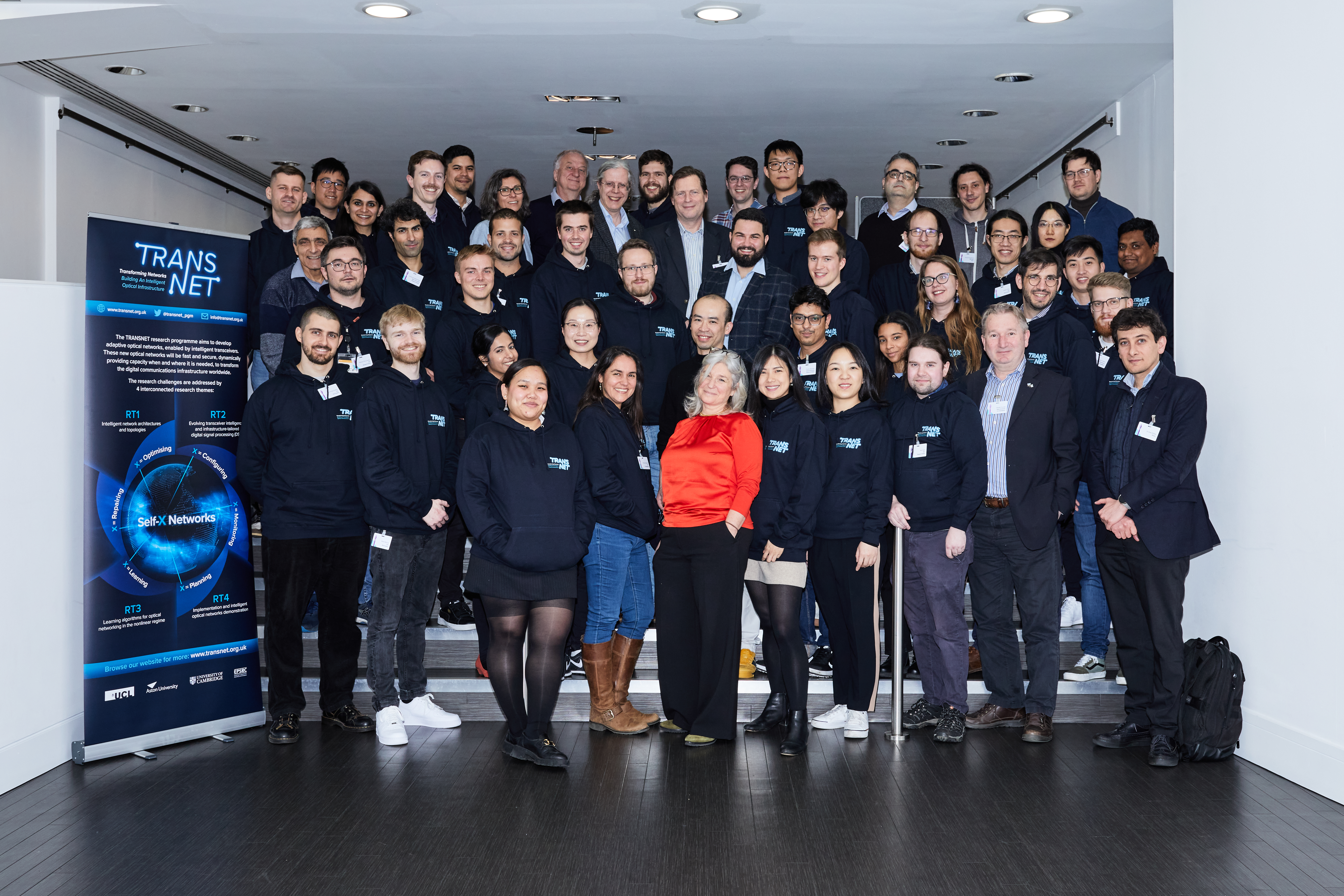
TRANSNET: Celebrating 8 years of scientific legacy in optical communications
More than eight years ago, TRANSNET was proposed to address one of society’s greatest technological challenges and economic drivers: ensuring the availability of ubiquitous, high-capacity, low-latency, resilient and secure digital infrastructure. From the outset, the programme recognised the need to develop networks capable of supporting the evolving and unpredictable demands of society, industry and government.
Over the duration of the programme, the importance of this mission has only become more apparent. From the unprecedented shift in digital connectivity brought about by the COVID-19 pandemic to the rapid emergence of AI, the demands placed on our communications infrastructure have evolved at an extraordinary pace, reinforcing the critical need for the research supported by TRANSNET.
Now, after more than 600 publications, the training of over 50 PhD students and almost 200 awards and recognitions, the TRANSNET programme has officially concluded! It has been a privilege to contribute to an area of research so fundamental to the future of the UK and beyond. We extend our sincere thanks to the many partners, collaborators and supporters whose contributions have been instrumental to the programme's success.
As we prepare to publish our final newsletter and host our closing event, we reflect on some of TRANSNET's most significant achievements and the lasting legacy of its research.
Shaping modern industrial strategy
TRANSNET has played an important role in strengthening the UK's sovereign capabilities in digital communications, while contributing to the development of industry standards and informing government policy on infrastructure capability, security and broadband delivery. As networks evolve from being manually provisioned towards autonomous entities, the programme's research has helped provide the scientific foundations needed to inform future policy and decision-making.
Most recently, Professor Sergei Turitsyn provided evidence to the House of Commons Science, Innovation and Technology Committee as part of its inquiry into low-energy computing. The inquiry, which is expected to inform future government policy on AI, energy and advanced computing infrastructure, is examining opportunities to reduce the energy footprint of increasingly computationally intensive technologies. Sergei highlighted the potential of neuromorphic computing to deliver substantial reductions in power consumption while maintaining high performance.
TRANSNET's engagement with government has also contributed to wider discussions about the UK's strategic position in photonics and related technologies. Professor Polina Bayvel hosted a visit from the Government Office for Science, providing an opportunity to explore how the UK can build on its research strengths and reinforce its international leadership in the sector. Following the visit, the Council for Science and Technology wrote to the Prime Minister outlining opportunities for economic growth and global leadership in photonics, including the potential development of a national photonics roadmap to coordinate research, skills and investment.
Pushing the boundaries of optical communications
TRANSNET has played a significant role in strengthening the UK’s position at the forefront of optical communications research, bringing together expertise in high-capacity optical transmission, intelligent networks and machine learning to address some of the most pressing challenges facing future communications infrastructure.
Among its most notable achievements is a world-record optical fibre transmission speed of 450 Tb/s, achieved through an international collaboration involving UCL, the National Institute of Information and Communications Technology (NICT), Lightera, Nokia Bell Labs and Aston University. Demonstrated over field-deployed optical fibre, the breakthrough highlighted the potential to dramatically increase the capacity of existing communications infrastructure with ultra-wideband technology, an increasingly important challenge as global data traffic continues to grow. The achievement attracted significant international attention and mainstream media coverage, showcasing the strength of UK-led research and the value of collaboration between academia and industry.
Translating research into real-world innovation
Beyond its scientific achievements, TRANSNET has helped translate pioneering research into commercially viable technologies, demonstrating how advances in optical communications can address emerging challenges across the wider technology sector.
A standout example is Oriole Networks, a UCL spin-out co-founded by TRANSNET Co-Investigator Professor George Zervas. The company raised £35 million in funding within its first year and is developing innovative photonic networking technologies designed to improve the performance and energy efficiency of AI infrastructure.
Developing the next generation of research leaders
Alongside its technological advances, one of TRANSNET’s most significant achievements has been the development of highly skilled researchers who are now shaping the future of optical communications across academia and industry.
Since the programme began, TRANSNET early career researchers have received more than 15 prestigious awards, including competitive scholarships, research grants and prizes. Seven researchers have also secured fellowships, enabling them to establish independent research programmes and pursue new directions in optical communications research. Among them are Dr Eric Sillekens and Dr Kari Clark, both of whom completed their PhDs within UCL’s Optical Networks Group and TRANSNET before receiving highly competitive Royal Academy of Engineering fellowships. These awards have enabled them to establish their own research groups, extending the programme’s influence through new research activities and the development of future generations of engineers.
The success of TRANSNET researchers extends well beyond academia. Of the early career researchers trained through the programme, 35% have continued in academia, while 65% have moved into industry, joining leading international organisations including Nokia, Microsoft, Sony and BT.
Every TRANSNET-trained early career researcher has remained within the field of optical communications, proving the lasting relevance of the expertise developed through the programme. Their continued contributions are helping to strengthen the talent pipeline between universities and industry, ensuring that advances in optical communications are supported by the specialist skills needed to bring them into practice.
A lasting legacy for optical communications
As TRANSNET draws to a close, its achievements reflect the scale of impact that can emerge when ambitious scientific research is combined with international collaboration, industry engagement and investment in developing talent. Supported by the Engineering and Physical Sciences Research Council (EPSRC), TRANSNET leaves behind a legacy that extends far beyond the lifetime of the programme. Its researchers and alumni will continue to drive innovation and help address the growing global demand for faster, more intelligent and energy-efficient communications networks.