New Publications from TRANSNET Cambridge Team
Our team at Cambridge have been hard at work, with two of their latest papers recently accepted and published in Journal of Lightwave Technology, and another presented at 2025 International Conference on Optical Network Design and Modeling (ONDM). Covering a range of topics, from coherent-lite transceivers to optical power spectrum predictions and generative design of network topologies, these papers greatly advance us towards our goal of creating adaptive and intelligent optical networks. Below is a brief overview of each publication, please follow the links to find the full papers and read further.
Simplified Transceivers for Short-Reach Coherent-Lite Systems
While coherent transceivers are widely deployed for long-haul transmissions, short-reach systems predominantly rely on intensity modulation with direct detection. This paper reviews coherent-lite transceivers, simplified coherent systems that aim to balance performance, power efficiency, and cost. The authors analyse various digital and photonic solutions for designing coherent-lite systems for both data center networks and access networks, addressing future data rate requirements beyond 800 Gbit/s for data center interconnects and 200 Gbit/s for passive optical networks. The review highlights that coherent-lite systems are a promising technology for enhancing intra-data center connectivity. To address the cost constraints of large-scale access network deployments and the growing need for higher data rates, they suggest that passive optical network systems adopt a tailor-made coherent-lite solution coupled with simplified coherent receivers.
Optical Power Spectrum Prediction using Cascaded Learning with Uncertainty Propagating Noisy Input Gaussian Processes
The demand on optical communication infrastructure is ever-increasing with the rise of data centers and 6G technology. It is therefore important that the optical performance of the network can be modeled through estimation of metrics such as the channel power spectrum or optical signal-to noise ratio (OSNR) that are used for accurately estimating the quality of transmission (QoT) of a signal. This paper reviews and advances modeling methods for predicting optical power spectra, comparing traditional black-box neural networks to more transparent, component-level Gaussian Process (GP) models. A novel “uncertainty-propagating” GP framework is introduced where each amplifier is modeled individually, allowing the uncertainty output by one model to be input into the subsequent model. Experimentally, the approach outperforms neural networks and standard GPs, achieving higher accuracy and requiring 86% less training data.
Topology Architect: Graph Generative Intelligence for Scalable Optical Network Topology Design
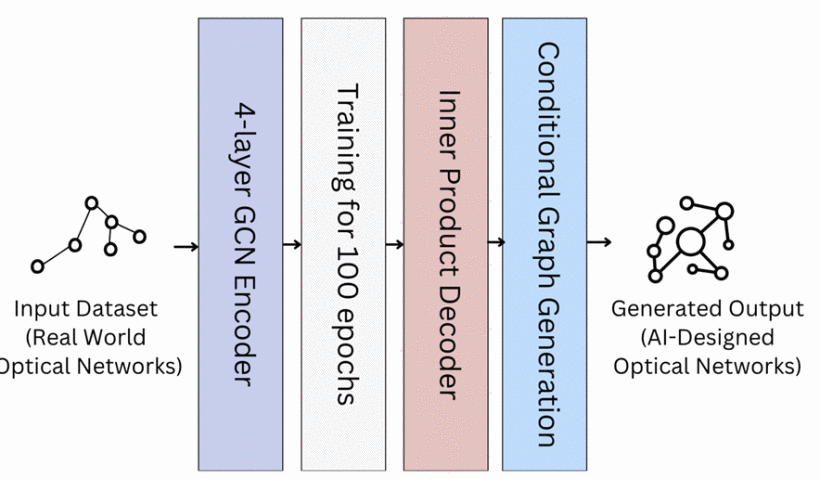
The design of an optical network's physical topology is critical for its performance, but the intelligent and automated design of scalable optical networks remains challenging. This paper introduces Topology Architect, the first generative AI model for optical network design, which is able to generate realistic, scalable topologies using only node counts and geographic coordinates - trained on TRANSNET's previously developed dataset, Topology Bench. It achieves up to 95% graph similarity and generates user-defined topologies in less than a second, presenting a novel framework for optical network topology generation.